
Restoring Confidence in the University of Wyoming
Scott Yenor
Washington Fellow
Share this article
 X
X
 Facebook
 Truth Social
Click here to view a PDF version of this article.
Executive Summary
Conservatives have been frustrated with the direction of higher education for decades. Yet conservative responses like protecting free speech and ending racial preferences have not kept the higher education machine from veering ever leftward. Nor will ending tenure or greater transparency change higher education’s direction. Reformers must start with reforms that will change the direction of higher education from within the system; then, they must change the system itself.
The Wyoming legislature should start with clarifying the educational mission at the University of Wyoming (UW). Clarifying its mission will help UW to cut ill-suited units from campus and restore the citizens of Wyoming’s confidence in higher education.
UW will soon have to conduct program reviews to balance the books owing to declining enrollments. Program reviews are a legitimate way within the current system to cut unwanted, corrupt units and programs on campus. They are conducted regularly at most universities, including at UW. Program reviews respect tenure. They are acceptable within current accreditation standards. Wyoming’s legislature should shape the program review process through all available levers of power. Tomorrow’s program reviews would cut underenrolled programs and programs where ideological content corrupts professional standards. Cutting corrupt disciplines from UW will help restore confidence in Wyoming’s flagship institution—and it will also set UW apart from other public universities for a distinctively nonwoke flavor.
As UW currently conducts program reviews, political judgments should make for over half of the program review criteria, but UW usually falls back on strictly budgetary factors. Wyoming’s legislature should take the reins to ensure that UW’s strategic goals are consistent with its own educational vision. The legislature should continue programs that provide scientific literacy, an appreciation of Western civilization, professional education like law, engineering and nursing, and workforce education. The legislature should also eliminate programs in which professional standards are indistinguishable from those with a partisan or strictly ideological bent.
This report explains the budgetary implications of enrollment declines at UW and shows how program reviews could make UW leaner and better. A new approach to program reviews will allow UW to remove programs that are inconsistent with the state’s educational vision and to build programs that support the state’s needs. Defining the state’s needs cannot simply be left to UW’s faculty and administration. The people of Wyoming, through their elected representatives, should weigh in, too.
A program review of this sort will restore confidence in higher education in the state of Wyoming. Degree programs like Gender & Women’s Studies and African & American Diaspora Studies should be discontinued. The same goes for majors or departments such as Anthropology, Religious Studies, and Sociology.
Part 1: The Context for Program Reviews in Wyoming
Enrollments at American universities have been declining for a decade. Between 2010 and 2021, undergraduate enrollments dropped from just over eighteen million to 15.4 million. Enrollments are down over 4 percent at public four-year universities and over 5 percent at four-year private universities since fall 2022. Enrollments have been declining at a rate of about 1.5 percent a year since 2011 according to the National Center for Education Statistics.[1]
Part of this is simply demographic. Fewer births years ago means fewer college-age adults now. Birth rates went down almost 25 percent between 2007 and 2022 nationwide. Demographers predict that enrollments will drop about 15 percent every four years as those born after 2007 come of college-age. The number of high school seniors nationwide will decline by about 100,000 students per year after 2024–25.[2] Enrollment declines will accelerate as the children born in 2017—when birthrates declined to under 1.8 total fertility per woman (birthrates fell to 1.62 in 2023)—and beyond reach college-age in 2034.
Steep drops in public confidence due to the increasing political radicalism on campus also explains why enrollments are down in higher education. An ideological shift toward activist liberalism and radical leftist ideology in academe has been underway for decades, but it accelerated after 2010.[3] Several well-known studies document this slow, steady turn to leftism. Partisan affiliation among professors has lurched hard left since the early 1990s. Today, well over 60 percent of professors identify as liberal, while under 10 percent are conservatives.[4] As early as 2007, nearly half of faculty thought it was their job to “encourage students to become agents of social change.” That number increased to 81 percent in 2016.[5]
As the professoriate prioritized political pedagogy, the American people soured on higher education. This is especially the case among conservatives.[6] According to Gallup, the percentage of Americans with “very little” confidence in higher education has ballooned from 9 percent in 2015 to 22 percent in 2023. Fully 62 percent of Americans in 2023 had only some or very little confidence.[7] A recent study from the Bill and Melinda Gates Foundation catalogues how people under thirty increasingly see higher education as less important or valuable.[8] As a result, a lower percentage of high school graduates are attending college. “Only 39% of young men who have completed high school are enrolled in college” in 2023, according to Pew Research, “down from 47% in 2011.”[9]
UW has not been immune to the problem posed by lower birthrates and lower public confidence in higher education. UW enrollment remained steady at over 13,500 students until 2016–17. Then, a crisis hit.[10] Enrollments fell from over 13,700 in the fall of 2015 to around 10,800 in 2024, a decline of roughly 30 percent over the decade.

Most of UW’s students are from Wyoming—about 59 percent in 2024.[11] The number of in-state students at UW has hovered around 60 percent for years. A relatively high number of Wyoming high school graduates leave the state for higher education (about 30 percent). Wyoming’s high school graduates go to college at lower rates than their equivalents in other states. According to a recent study for the National Student Clearinghouse Research Center, Wyoming had the largest decrease in the percentage of students enrolling in higher education in the country between 2023 and 2024 (a 20.3 percent decrease).[12] That hurts UW; it also indicates that there will be more enrollment declines if current trends continue.
Part of the story seems simple: Wyoming is among the most conservative and Republican of states in the Union. UW depends on in-state attendance more than many other flagship universities. As conservative and Republican confidence in higher education declines, enrollment declines most among Republicans. And such enrollment declines will fall harder on states like Wyoming and West Virginia, also a very conservative and Republican state.. Declining enrollments have profound effects on universities. They hurt morale. They can force universities to conduct program reviews as a means of trimming budgets. In fact, having a process whereby programs can be reviewed is necessary under today’s accreditation system. The Higher Learning Commission, which accredits UW, requires that institutions maintain “a practice of regular program reviews and acts upon their findings” (criteria 4A).[13] Program reviews allow institutions to assess the quality and effectiveness of academic programs to improve the programs or to align programs better with the university’s mission. Program reviews also allow universities to target programs for trimming or elimination—tenured faculty and associated staff can be laid off or fired if the university can no longer afford the program or if the program lies outside the university’s mission.
Public universities and private colleges across the country are conducting program reviews to shrink staff and program offerings to meet declining enrollments. In November 2024, private universities like Saint Augustine’s University in Raleigh, NC, Drexel University in Philadelphia, the University of Denver, and the American University in Washington, DC announced reorganizations to save money. Public universities are hardly immune to enrollment declines. The University of Akron,[14] West Virginia University (WVU), and San Francisco State University (SFSU) responded to declining enrollments with program cuts or faculty and staff layoffs.[15] SFSU has seen a drop from over 29,500 students in 2018 to just over 22,000 in 2024—and the university responded to this drop by laying off a significant number of faculty in its reorganization.[16] Every month, different colleges and universities announce program reviews to meet cratering enrollment.[17] More than a dozen institutions close every year.[18]
Most program reviews around the country resemble WVU’s, which was conducted in the fall of 2024. The key matrices for conducting program review in West Virginia involved mostly enrollment, enrollment trends, faculty-student ratios, and expense trends. State priority or missional considerations for the program were “additional considerations” but those mission analyses did not shape the actual evaluation of the programs. And they were not part of the appeals process either, at least as a matter of practice.[19]
Important programs will often be dropped – and corrupt programs will often be kept – if saving money alone solely drives program reviews.

As a result, at least as we see from the publicly available documents, programs at WVU seem to have been evaluated strictly on a cost-saving basis, not including or quantifying mission aspects. Almost every dropped program had significant and sustained enrollment decreases and low student-faculty ratios. Programs were dropped even if they were in line with WVU’s land grant vision.[20] The Department of Engineering saw faculty reductions in the Civil Engineering degree. The Biometric Systems Engineering degree was discontinued, as was Petroleum and Natural Gas Engineering. Yet Women’s and Gender Studies was merged with Sociology and Anthropology, presumably to improve its numbers and help its long-term viability.
Why is Petroleum Engineering gone, while Gender Studies stays? The answer lies in the details of program review.
WVU resembles UW in that both are land-grant institutions in conservative and Republican states. Both are experiencing enrollment declines. No program review can ignore the economic realities, but WVU provides the classic example of how ignoring educational missions in program reviews reinforces the university’s dominant left-wing bias. Some room—much room, in fact—needs to be made for ensuring that a program review sows into its process the centrality of programs to the mission of the school. Important programs will often be dropped—and corrupt programs will often be kept—if saving money alone solely drives program reviews.
Program reviews are coming to UW sometime soon. Just when this will happen depends on several factors. UW is less tuition-dependent than many colleges and universities. It receives a direct subsidy from the state known as a block grant. The block grant approach represents a trade-off: the legislature gets sufficient information about where the monies will go, but does not micromanage how the university operates.[21] The block grant is about $340 million for the biennium starting July 1, 2024. Additional specific legislative appropriations are made for special projects like library collections, upgrading technology, and building maintenance.[22] The block grant makes up about 40 percent of UW’s revenue. The block grant makes UW less dependent on tuition than other universities are. Wyoming law requires in-state “tuition to be as nearly free as possible” (Title 21.17.105).[23] UW has the second lowest in-state tuition and fees ($6700) among flagship universities behind only the University of Florida. Since the block grant subsidy remains the same for two-year periods regardless of how many in-state students UW gets, a shortfall of students will not be immediately devastating. UW fell short of its projections by about one hundred students in 2024–25. This only cost the university about $700,000 in lost tuition revenue. Declining enrollments may lead to lower numbers in the block grants in future budgeting, however. Certainly, the legislature should consider the compliance of UW with state law when deliberating on the size of the block grant in the 2026 budget session.
Part 2: Program Reviews, Yesterday and Tomorrow
Yesterday’s Program Reviews at UW
UW conducted a program review in 2021 to meet a budget shortfall. If current enrollment shortfalls continue or if the legislature cuts the block grant, at some point soon, UW will once again have to conduct a program review. Program reviews should not only be used to balance the books. They should also be used to restore confidence in UW among Republican lawmakers and Wyoming citizens. This will mean a real rejection of Diversity, Equity, and Inclusion policies and offices and a redirection of education away from leftist disciplines toward workforce education, scientific literacy, and an appreciation of Western Civilization as required under the relevant Wyoming statute (see WY Stat 21-17-102).
The days of strictly economic program reviews should be over in Laramie
UW’s mechanism for program review is Regulation 2-13, which establishes a process whereby UW can “reorganize, consolidate, reduce, and/or discontinue academic programs for educational, strategic, realignment, resource allocation, budget constraints, or combinations of educational, strategic, and/or financial reasons.” This regulation has long existed. Units deemed too expensive or that do not serve UW’s educational vision can be discontinued or trimmed. Ultimately, the power of program review lies in the hands of UW’s president with the approval of the board of trustees, though Regulation 2-13 sets a process in motion to gain consensus across campus for any changes.
UW’s 2-13 was invoked in 2021 when the university faced a significant deficit owing partly to persistent enrollment declines. As the program review was underway in 2021, a faculty committee judged UW’s programs, as did the provost’s office independently. The two committees had distinct criteria for evaluating UW programs, as depicted in charts 1 and 2. Most of the criteria for judging programs were mission-based. Among these criteria, department or degree programs were judged on how they served the “UW mission” (about 30 percent of the total for the faculty committee and 40 percent for the provost), whether they met the “needs of the state” (12 percent for faculty, about 4 percent for provost), and whether they served the strategic plan (provost 15 percent). These inherently political judgments, depicted in red, officially constituted about 50 percent of the program evaluation points for the faculty committee and nearly 70 percent for the provost evaluation. Mission matters.
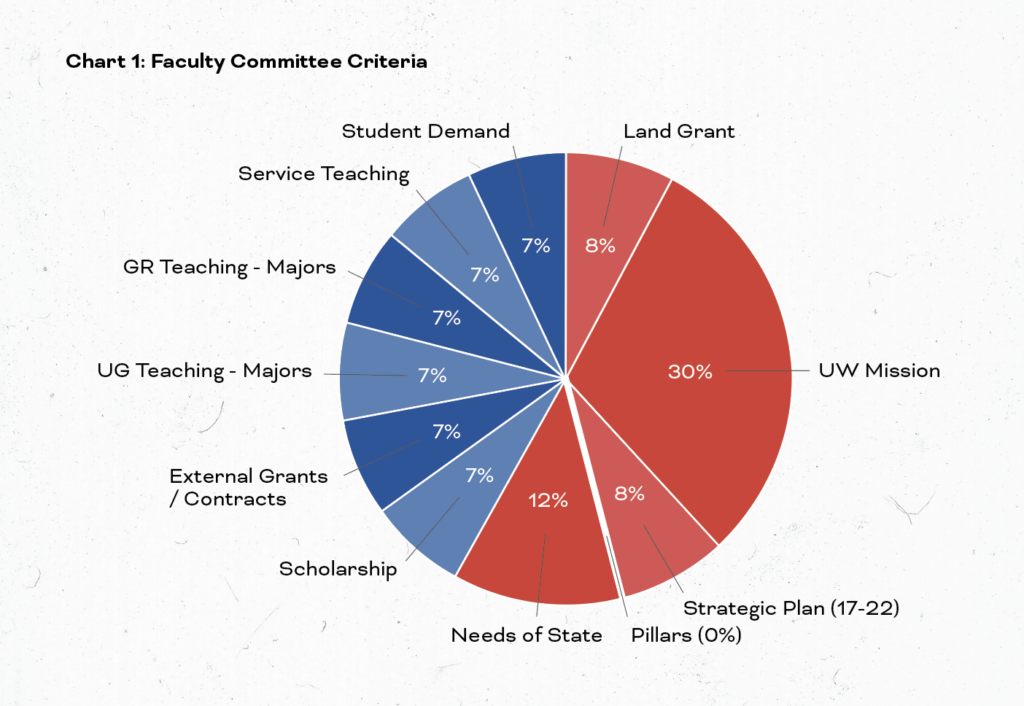
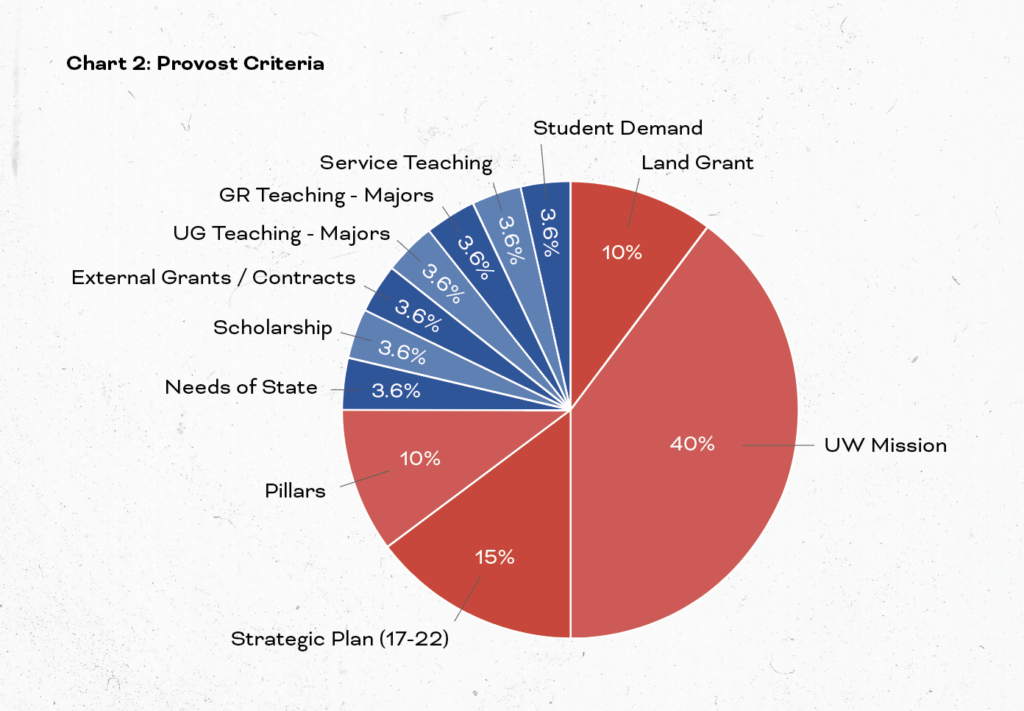
The remainder of the program points, depicted in blue on the pie charts, came from the number of students enrolling, student growth, employment prospects, the productivity of the faculty, the performance of departments in securing external grants, and other measurable economic factors. These “blue points” are the kinds of strictly academic, numerical factors that drove the WVU program review.
Mission-fit or “red” factors should have driven UW’s program review, that is, but it appears that economic or “blue” factors did in 2021. The School of Culture, Gender, and Social Justice, for instance, was judged to be a “moderate to low” growth area for enrollment, with moderate to falling prospects for employment. It was undersubscribed, had very few majors, and was not overly popular among UW donors. (No record of how mission-based factors figured in the analysis can be found in the analysis charts.) The program was judged to be in the lowest quintile by both the faculty committee and the provost. Yet the School of Culture, Gender, and Social Justice remained after the program review—its three professors, two assistant professors, four lecturers, and two visiting professors kept their jobs. A possible savings of more than $500,000 was foregone to save the School of Culture, Gender, and Social Justice.
Veterinary Science had similar underenrollment problems to the School of Culture, Gender, and Social Justice. It had low student growth and “moderate to low” employment prospects. It had relatively high institutional costs per credit hours too—much higher than the School of Culture, Gender, and Social Justice. Yet the committees judged Veterinary Science in the second highest quintile for importance since the discipline is practically mentioned in UW’s statement of purpose. The same is true of Petroleum Engineering. The “red” factors are figured into the program analysis, but it is not clear where or to what extent.
UW’s 2021 restructuring created efficiencies more than it eliminated programs. It consolidated academic units and discontinued several bachelor’s degree programs (Spanish/French/German language education degrees, for instance). It did the same to advanced-degree programs. The Department of Chemical Engineering was eliminated, and chemical engineering degrees were transferred to the Department of Chemistry. Departments in the College of Arts and Sciences were reduced while the College was expanded to cover Social Sciences, Humanities and Art. About fourteen million dollars were saved, and seventy-five positions, hardly any with tenure, were eliminated.[24]
Many universities simply ignore mission-based factors. UW understates and obscures them. Future program reviews should combine budget savings concerns with an explicit, intentional willingness to exorcise one-sided, ideological programs that undermine the confidence people have in UW. The days of the strictly economic program reviews should be over in Laramie.
The state’s needs—the “red” factors in the charts above—point to what the state is now and what the state hopes to use higher education to become. Some degree programs are so unprofessional and infused with one-sided ideological content that they do not meet the state’s needs for professionalism and objectivity; nor do they reinforce the state’s values or aspirations.
Tomorrow’s Program Reviews at UW
Wyoming’s legislature, therefore, could and should help to determine which programs meet the state’s educational vision. Wyoming should not be funding academic units whose professional standards are infused with ideological and partisan goals.
Toward this goal, it is necessary as a first step to rearticulate UW’s educational goals and to recalibrate them for today’s hyperpartisan professoriate. UW is supposed to provide “a liberal education, together with a thorough knowledge of the various branches connected with the scientific, industrial, and professional pursuits” (WY Stat 21-17-102). The Wyoming legislature should modify and elaborate on these high-minded goals and side with professionalism and objectivity and against the predominance of identity politics in university offerings. Liberal education includes rejecting identity politics and embracing an objective, professional study of the great works, our civilization, and our culture.
The Wyoming legislature should create a North Star for university activities. Program selection at UW should be made consistent with the purpose of the university, with its emphasis on “liberal education” and “scientific, industrial and professional pursuits.” Programs inconsistent with these goals should not be introduced; if they have been introduced, they should be discontinued.
The legislature should adopt language about programs that are to be disfavored. To borrow liberally from Florida’s SB 266,[25] the foundational higher education reform bill of Governor Ron DeSantis, programs should align with the university’s mission. The following statement, or the idea it expresses, should be added: “Programs based on theories that systemic racism, sexism, oppression, and privilege are inherent in the institutions of the United States and were created to maintain social, political, and economic inequities will not be funded through state appropriations or through other means.” A program’s alignment with UW’s mission should be as important as a program’s viability with respect to student enrollments and cost measures. It should be made operational within the criteria. The statement should stigmatize ideological disciplines using objective measures.
The board of trustees would ensure the quality of program reviews, and relevant legislators might serve on program review committees. Faculty and the provost are not well-placed to make determinations about mission-based alignment. Faculty should not be judges in their own cases. They are certainly ill-suited to judge programs on whether they meet the state’s educational vision, given their tendency to support every radical program on campus. A predominantly leftist or ideological faculty will have a very different vision of the state’s needs than elected officials in the state. Provosts are often thought to be more respectable and responsible. They are also defenders of the university’s status quo and are usually unwilling to disrupt programs. Measures of “needs” are not simply economic anyway.
What might such a new approach to program reviews look like?
Part 3: Applying the New Standard for Program Reviews
A Framework for Identifying Programs Infused with Identity Politics
A program review board should seek independent evidence to verify the political nature of disciplines. Does the discipline’s national organization characterize American civilization, or civilization as such, in terms of structures of oppression? Does it argue that ideology simply masks a defense of existing inequities? Does such an attitude predominate in the discipline’s leading journals? Does the faculty at UW share this view? Does the research of the faculty members have an identity politics bent? Do course syllabi? Programs could be put into three or five categories, according to how thoroughly ideological content determines professional standards. Gender Studies and Religious Studies (illustrations below) would receive the highest scores, since ideological content is indistinguishable from professional standards in demonstrable ways in those disciplines. They should be targeted for removal. Physics and Engineering would receive the lowest scores.
Gender Studies
Gender Studies programs survived the 2021 program review. Neither the Gender & Women’s Studies major in the School of Culture, Gender, & Social Justice nor the African & American Diaspora Studies major in the same school produces many graduates. The branches of Gender & Women’s Studies have never yielded more than thirteen majors since 2020 and African & American Diaspora Studies has never yielded more than five. UW might have phased out these low-performing majors in 2021. It is a wonder it did not. The fact that the program review kept those majors reflected a political judgement that such majors are important for the future needs of the state and to UW’s mission. (Note that table 2 omits American Studies, which was added to the School of Culture, Gender, and Social Justice in 2022.)

Program review would lead to eliminating ideological activism from UW more effectively than budget cutting does.
In fact, UW thought the School of Culture, Gender, & Social Justice was so important that the president and board of trustees approved moving a higher-performing set of majors under the umbrella of American Studies into the School after the 2021 reorganization. The inclusion of American Studies boosted the School’s numbers by more than 100 percent and made the school look more economically viable (the school’s number of majors went from twenty-seven in fall 2021 to close to eighty in subsequent years when American Studies was included). This is why showing that a unit is economically costly is not enough for program reviews. UW may have added American Studies to the school to ensure its viability in the future, when only cost-savings appeared to matter in program review. Wyoming must ultimately get behind the idea that majors like these are inconsistent with the state’s educational mission. Political judgments are inescapable, and UW’s faculty and administration make those judgements for the state legislature now.
There was solid good sense behind the proposal from Wyoming’s state senator Cheri Steinmetz (R-Lingle), who sought to bar state funding for “gender studies courses, academic programs, co-curricular programs and extracurricular programs.” Wyoming’s state legislature is well within its power to set academic priorities through the budget. Wyoming statute holds that the legislature “shall appropriate monies” and “specify the purposes for which the monies are intended to be used.” This general-purpose law applies to UW as well. Shaping program review is the most effective way to eliminate such programs. If there is a problem with Senator Steinmetz’s approach, it is this: The proposal is too specific and too focused on gender studies. Other programs are inherently political and activist as well and this concern should factor into whether or not UW keeps them after program review. Program review would lead to eliminating ideological activism from UW more effectively than budget cutting does.
As Senator Steinmetz implied, gender studies is among those unprofessional, ideological pseudodisciplines according to objective criteria. Such ideological and dogmatic disciplines have no place in the university. Everyone can see that gender studies is inseparable from ideology. Our objective framework should guide the analysis.
National Organizations
The discipline has a national organization, with an annual national meeting, where its alignment with leftist activism is clear. The National Women’s Studies Association holds that inequities are traceable to “identity, power and privilege” and that “structures of inequality” can only be fought through a transnational feminist revolution that the discipline aims to promote.
Leading Journals
Nearly every academic journal in gender studies embraces the identity politics framework.[26] Gender & Society is arguably the leading journal in this realm. Every article in the latest edition accepts identity politics as its necessary starting point and frame of reference. Mountains of evidence could be collected to show that political standards are sown into the discipline’s professional standards.
UW Mission Statement and Learning Outcomes
The goals of UW’s Gender Studies program are to “analyze socio-historical and contemporary power dynamics across rural, local, community, transnational, and global contexts”; “articulate the history, strategies, and goals of interconnected movements for social justice”; and “perform and develop intersectional, interdisciplinary feminist and queer analysis.”
UW Courses
Nearly every course in Gender & Women’s Studies (GWST) confuses professional and political standards. The Intro to Gender & Women’s Studies course is among the core courses. That class is based on “gender, feminist, and intersectional theories.” Its core courses include choosing either Feminist Theories (GWST 4700) or Queer Theory (GWST 4430). Among the elective courses offered (students must take seven of them) are Psychology of Gender, Gender and Race in the Economy, Race, Gender, Ethnicity in the Media, Ecofeminism, and Queer Life through Memoir. I am confident a closer examination of these syllabi would make the department, and especially its course offerings, look even more unserious.
In sum, gender studies is undersubscribed (remember: it has never yielded more than thirteen majors per year since 2020) and it is inherently infused with identity politics. Its degree programs should not survive program review and its associated faculty should be fired. In fact, several other programs in the School of Culture, Gender, & Social Justice would not survive such an inquiry. The BA in African & American Diaspora Studies has yielded only eight majors in the past five years. The Secondary Bachelor’s in that program has had only six graduates in five years. The Queer Studies minor program is almost certainly also undersubscribed. Furthermore, each of these programs is infused with identity politics and does not belong at UW or any other university.
BA in Religious Studies and Secondary Bachelor’s in Religious Studies
The Department of Religious Studies and Philosophy has produced between thirty-two and forty-eight majors each year since 2021, with Religious Studies degrees producing about one third of these. Philosophy has approximately six tenured faculty members and one assistant lecturer. Religious Studies has about four permanent faculty and one lecturer. It is a low-performing department with about fifteen majors per year. The department would be low-priority according to strictly economic measures, but the state might still keep the department if it were thought that no university could exist without a philosophy or religious studies degree. Philosophy may fit into the category of “uneconomical, but essential” for the university’s mission.
In addition to not attracting enough students who wish to study it as a discipline, religious studies is, as one scholar contends, “one of the most ‘woke’ disciplines on college campuses” and is “an ideological wolf in sheep’s clothing.”[27] Religious studies is not about religious practice. Instead, it is a celebration of multiculturalism, often with more emphasis on sympathetic treatment of African religions, Islam, Buddhism, and Hinduism, together with wholesale condemnation of Christianity. It views religion as merely a human creation—and studies its effects through the lens of identity politics.
Does the discipline of religious studies as currently constituted meet the needs of the state? Is it so ideologically corrupt that it does not belong at a university? A program review board should seek independent evidence to verify the political nature of disciplines in general, including religious studies. Does the national organization tend toward identity politics? Do its leading journals do the same? Do the faculty at UW? Is the research of the university’s faculty members biased in favor of identity politics? Are course syllabi?
National Organization
The leading scholarly association for religious studies is the American Academy of Religion. Its annual meeting is organized into program units that have presidential themes, the most recent of which include “Violence, Nonviolence, and the Margin” (2024), “Religion and Catastrophe” (2022), and “Religion, Poverty and Inequality” (2021). The 2016 annual meeting featured more than forty LGBTQ events or panels,[28] in addition to some that were less obviously political. The same was true of the 2017 annual meeting, though ubiquitous emphases on then-President Trump as a threat to “free inquiry, diversity, inclusion and respect” were present. Topics on the cutting edge of the progressive Democratic party dot the programs. These include socialism, immigration reform and open borders, climate change, criminal justice reform, identity politics, homophobia, transphobia, and the like.
Leading Journals
The Journal of the American Academy of Religion is among the leading journals in the field. It is as political as the national organization that sponsors it. Nearly every article in the March 2024 issue centers around themes of identity politics or multiculturalism. One such article concerns “authorizing Western multicultural societies today.” Another seeks “decolonization of the field.” The next crafts “a new history of American evangelicalism to counter the politicized, right-wing faith of their era.” Every article, in one way or another, serves the Left’s political agenda—by hook or by crook. Further research would be needed to show that this goes back several years, almost certainly revealing that the rot runs deep.
UW Mission Statement and Learning Outcomes
The landing page of UW’s Department of Philosophy & Religious Studies begins with the following statement. “We believe all people, regardless of race, gender, or sexual orientation, deserve equal treatment under the law, equal representation, equal opportunity, and equal access to public discourse.” It speaks of the desire to publicly establish “a more just and inclusive society,” and it asserts that “we are morally obligated to build” on the view that individuals “should not be essentialized according to their race, gender or sexual orientation.” The mission “condemn[s] government attempts to infuse political ideologies, whether liberal or conservative, into the university and its programs through legislation.” Regardless of whether or not one agrees with these sentiments, that the simple fact that these are the very first words on the department’s landing page reveals its central commitments. The department is not, first and foremost, dedicated to philosophy or religious studies as such. On the contrary, its fundamental commitment is to controversial political goals. In fact, the department claims to “welcome all students who aspire to make this a better world,” implying that its primary purpose is a particular vision of political activism.
In sum, in religious studies, professional standards are indistinguishable from partisan, ideological standards. The religious studies program at UW is also undersubscribed when it comes to majors. It should be cut from the university.
Part 4: The Cost of Ideological Programs
Other programs could also be cut for ideological reasons. Critics of anthropology like Elizabeth Weiss claim that “identity-based interest groups are destroying a rich academic discipline”; indeed, she uses many of the criteria I have outlined above to make her point.[29] Critics of sociology are legion—and the discipline is hopelessly lost and ripe for program review.[30] Sociology has been combined with criminal justice at UW—but its poor numbers as a major discipline of study show that it, too, is relatively undersubscribed.
The costs of ideological programs are also, of course, economic. They divert funds away from other activities and they provide a state subsidy for partisans under the guise of academic respectability. As depicted in table 3, places like UW, where budgets are tight and enrollments declining, could save millions every year by cutting heavily ideological programs. Table 3 depicts only scheduled salary per selected departments—a number that vastly underestimates the cost savings from budget cutting since it does not include benefits, infrastructure, or administrative support for each of these departments.

The costs of ideological departments are also institutional. They make ideological orientation respectable. Faculty with such an orientation must be accommodated on committees. Peace is won through appeasing fanatics and pretending that they are serious scholars. Their presence insults the university’s mission. Physics professors are held to be doing the same thing as sociology professors. They both publish in peer-reviewed journals. They both have authority to teach the youth. Yet one of them is serious, while the other is likely to be an ideological joke. Even in the absence of a budget crisis, subtracting ideological programs adds institutional self-respect. If faculty worry that they are next on the chopping block, perhaps they should examine whether they should feel justly deserved shame about the nature of their discipline.
Many academic programs across UW would not survive program reviews that intentionally integrate mission-based questions. Among the most infused with ideological content are the following: the BA in Sociology and related sociology majors (about eight to nine faculty members for about sixty-five majors per year over the past five years); programs related to Anthropology (about fourteen faculty for roughly one hundred degrees per year); the School of Culture, Gender, & Social Justice minus American Studies (which could be relocated back to the Department of History); the Communication and Journalism Department; and the Division of Social Work. The history and English programs at UW should also be investigated.
Part 5: Conclusion
Budget crises test university administrators. They cut expensive, inefficient programs to balance the books. But economics is not enough. Economic as well as mission- and vision-based concerns should guide program cuts. Underperforming, inherently ideological programs should be eliminated during program reviews. In fact, why wait for budget crises to get rid of them? Budget crises could be avoided by cutting ideological programs now.
University rules guide program reviews. Wyoming legislators should shape program review rules, since reviews are inherently political. Boards and administrators should review existing academic programs for alignment with UW’s liberal arts, professional education, and workforce missions.
Several steps would improve program reviews:
- Wyoming’s legislature should expound on the higher education system’s mission statement to show that programs based on the theory that systemic racism, sexism, oppression, and privilege are inherent to the institutions of the United States and are created to maintain social, political, and economic inequalities have no place at UW.
- Wyoming’s legislature should direct UW and other institutions to conduct program reviews deriving criteria from the system’s mission statement equally with program performance metrics like enrollment trends.
- Wyoming’s legislature should use the block grant to encourage UW to cut programs infused with one-sided political activism, either by cutting the block grant by the amount of money that those programs cost or by directing UW to cut such majors and programs with all deliberate speed.
- Wyoming legislature should revisit the block grant approach to funding UW. The block grant works when university administrators are trusted to spend monies consistently with state purposes. Recent program reviews and UW’s defiance in the face of the legislature’s DEI ban in 2024 show that university administrators are not consistently operating with the wishes of Wyoming’s legislature.
Program review is an opportunity for addition by subtraction, where the narrow interest in balancing budgets helps achieve a healthy educational vision. The anti-intellectualism and the hard-edged ideology of certain programs do not belong on universities. Ridding UW of programs like Gender and Women’s Studies, Religious Studies, Anthropology, and African & American Diaspora Studies would restore confidence in UW’s administration. Closing down the School of Culture, Gender, and Social Justice—a school designed to be nothing less than a thumb in the eye of Wyoming’s conservative citizens—would save UW over a half million dollars. In fact, by my calculation, cutting the most ideological majors and departments would save UW nearly four million dollars.
Wyoming’s legislature could save UW from its own excesses and offer a more distinctive education for its citizens. To do this would restore confidence and, perhaps, pave the way to better days ahead.
[1] “US College Enrollment Decline—2024 Facts & Figures,” College Transitions, April 22, 2024, https://www.collegetransitions.com/blog/college-enrollment-decline/.
[2] Table 219.10, “High school graduates, by sex and control of school: Selected years, 1869–70 through 2027–28,” Digest of Education Statistics, National Center for Education Statistics, accessed January 3, 2025, https://nces.ed.gov/programs/digest/d17/tables/dt17_219.10.asp.
[3] Phillip W. Magness and David Waugh, “The Hyperpoliticization of Higher Ed: Trends in Faculty Political Ideology,” Independent Review 27, no. 23 (Winter 2022/23): 359–69, https://www.independent.org/pdf/tir/tir_27_3_05_magness.pdf.
[4] See Magness and Waugh, “The Hyperpoliticization of Higher Ed.”
[5] Daniel E. Hall, “Universities Must Create Space Where Contentious, Sometimes Hurtful, Discussions Thrive,” Cincinnati Enquirer, March 24, 2024. https://www.cincinnati.com/story/opinion/contributors/2024/03/24/universitys-must-return-to-institutional-neutrality-on-politics/73014540007/.
[6] Brandon Busteed, “Higher Education is Now the Most Politically Polarized Institution in America, on Par with the Presidency,” Forbes, July 12, 2023, https://www.forbes.com/sites/brandonbusteed/2023/07/12/higher-education-is-now-the-most-politically-polarized-institution-in-america-on-par-with-the-presidency/
[7] Megan Brenan, “Americans’ Confidence in Higher Education Down Sharply,” Gallup, July 11, 2023, https://news.gallup.com/poll/508352/americans-confidence-higher-education-down-sharply.aspx. Forty-one percent had only some or very little confidence in higher education in 2015.
[8] “Faculty Members’ Perceptions of Their Roles in Undergraduate Education, 2016–17,” Chronicle of Higher Education, August 18, 2019,https://www.chronicle.com/article/faculty-members-perceptions-of-their-roles-in-undergraduate-education-2016-17/; “Continuing to Explore the Exodus from Higher Education: Year Two,” Edge Research, HCM Strategists, and Bill & Melinda Gates Foundation, accessed January 3, 2025, https://static1.squarespace.com/static/62bdd1bbd6b48a2f0f75d310/t/65f0eb4cacac7722983f0582/1710287772754/HCM+%2B+Edge+-+Exodus+from+Higher+Education+Findings+Deck_FINALv4_031124_for+preso.pdf.
[9] Richard Fry, “Fewer Young Men Are at College, Especially at 4-Year Schools,” Pew Research Center, December 18, 2023, https://www.pewresearch.org/short-reads/2023/12/18/fewer-young-men-are-in-college-especially-at-4-year-schools/.
[10] See “University of Wyoming Student Data,” University of Wyoming, accessed January 3, 2025, https://www.uwyo.edu/oia/student-data/index.html; Jeff Victor, “Despite $1.5 Million Recruitment Campaign, UW Enrollment is Still Decreasing,” Wyoming Public Radio, September 30, 2024, https://www.wyomingpublicmedia.org/news/2024-09-30/despite-1-5-million-recruitment-campaign-uw-enrollment-still-decreasing.
[11] “UW Fall Enrollment Holds Relatively Steady,” University of Wyoming, September 26, 2024, https://www.uwyo.edu/news/2024/09/uw-fall-enrollment-holds-relatively-steady.html.
[12] “Current Criteria for Accreditation Effective September 1, 2020–August 31, 2025,” Higher Learning Commission, accessed January 3, 2025, https://www.hlcommission.org/accreditation/policies/criteria/2020-criteria/.
[13] National Student Clearinghouse Research Center, “Fall 2024 SI Special Analysis Dashboard,” accessed January 3, 2025, https://public.tableau.com/app/profile/researchcenter/viz/Fall2024SISpecialAnalysisDashboard/SIF24SpecialAnalysis. Other data sources also find large decreases in the percentage of Wyoming high school graduates going on to higher education. See Melanie Hanson, “College Enrollment & Student Demographic Statistics,” Education Data Initiative, last updated December 21, 2024, https://educationdata.org/college-enrollment-statistics.
[14] Krystal Vasquez, “University of Akron Proposes Cuts to Polymer Program,” Chemical & Engineering News, December 12, 2024, https://cen.acs.org/careers/employment/University-Akron-proposes-cuts-polymer/102/web/2024/12.
[15] Josh Moody, “Cuts at Saint Augustine’s, Drexel Among Steepest in November,” Inside Higher Education, December 2, 2024, https://www.insidehighered.com/news/business/cost-cutting/2024/12/02/cuts-saint-augustines-drexel-among-steepest-november.
[16] Max Harrison-Caldwell, “SFSU Lecturers Canned Amid Financial Emergency,” San Francisco Standard December 1, 2024, https://sfstandard.com/2024/12/01/sfsu-lecturers-canned-amid-financial-emergency/?utm_source=Iterable&utm_medium=email&utm_campaign=campaign_11908128_nl_Daily-Briefing_date_20241204.
[17] See Josh Moody, “October Brings Deep Cuts at Several Campuses,” Inside Higher Ed, November 4, 2024, https://www.insidehighered.com/news/business/cost-cutting/2024/11/04/october-brings-deep-cuts-number-college-campuses.
[18] Marina Villeneuve and Olivia Sanchez, “Tracking College Closures,” Hechinger Report, December 23, 2024, https://hechingerreport.org/tracking-college-closures/.
[19] Portland State University is undergoing program evaluation in 2024 as well. They use student credit hours per full-time equivalent, three-year trends in majors, number of degrees awarded, total student credit hours, net revenue, expenditures and other strictly numerical figures to conduct most of its program reviews, but it also preserves programs that score well on “value metrics” like “percentage of BIPOC students” and percentage of BIPOC faculty. See Program Review and Reduction Process (PRRP), Portland State University, accessed January 3, 2025, https://www.pdx.edu/academic-affairs/sites/academicaffairs.web.wdt.pdx.edu/files/2023-06/PRRP%20Final%20Report_0.pdf.
[20] See “Academic Transformation: Academic Portfolio Program Final Recommendations,” West Virginia University, September 15, 2023, https://wvutoday.wvu.edu/files/d/5f9f7860-2e7e-4919-9fbb-a101750eecf6/academic-portfolio-program-final-recommendations.pdf.
[21] Dan Richards of Wyoming Legislative Service Office, “Issue Brief: University of Wyoming Block Grant” September 2003, p. 4. See also the Report of the Management Audit Committee, “University of Wyoming: Effectiveness of Block Grant Funding” January 5, 2015, https://wyoleg.gov/progeval/REPORTS/2015/UniversityReportwithSupplement1-5-2015.pdf
[22] “A Message from the President: Legislative Actions Regarding UW,” University of Wyoming, March 23, 2024, https://www.uwyo.edu/news/2024/03/a-message-from-the-president-legislative-actions-regarding-uw.html.
[23] WY Stat § 21-17-105 (2023), Justia US Law, accessed January 3, 2025, https://law.justia.com/codes/wyoming/title-21/chapter-17/article-1/section-21-17-105/.
[24] See Michael T. Nietzel, “University of Wyoming Proposes Sweeping Academic Reorganization, Including Staff and Tenured Faculty Cuts,” Forbes, July 14, 2021, https://www.forbes.com/sites/michaeltnietzel/2021/07/14/university-of-wyoming-proposes-sweeping-academic-reorganization-including-faculty-and-staff-cuts/.
[25] Enrolled 2023 Legislature, Florida Senate, https://www.flsenate.gov/Session/Bill/2023/266/BillText/er/PDF.
[26] For a pretty complete list of journals in the area of gender studies, see “Academic Journals,” Women’s, Gender, and Sexuality Studies Program, Northeastern University, accessed January 3, 2025, https://cssh.northeastern.edu/wgss/academic-journals/.
[27] Mark Pulliam, “How Political Ideology is Pushing Religion out of Religious Studies”, James G. Martin Center for Academic Renewal, April 29, 2020, https://www.jamesgmartin.center/2020/04/how-political-ideology-is-pushing-religion-out-of-religious-studies/.
[28] “LGBTQ Guide to AAR and SBL Annual Meetings, 2016,” QSpirit, last updated January 13, 2024, https://qspirit.net/lgbtq-guide-aar-sbl-2016/.
[29] Elizabeth Weiss, “The Neo-Tribes of Anthropology,” James G. Martin Center for Academic Renewal, July 17, 2024, https://www.jamesgmartin.center/2024/07/the-neo-tribes-of-anthropology/.
[30] See, for example, Christian Smith, The Sacred Project of American Sociology (Oxford University Press, 2014); Alexander Riley, “Teaching Sociology is an Ideological Nightmare,” James G. Martin Center for Academic Renewal, July 10, 2024: https://www.jamesgmartin.center/2024/07/teaching-sociology-is-an-ideological-nightmare/; Alexander Riley, “Training Future Activists,” American Mind, November 12, 2023, https://americanmind.org/salvo/training-future-activists/.