
America’s 250th Anniversary Provocations
These essays are meant to provoke thought on where the country is headed and how badly things are going, and to propose solutions.

Summary: The controversy over birthright citizenship has generally been framed as a dispute over the meaning of a single sentence in the Fourteenth Amendment. Does the Citizenship Clause constitutionalize the English common-law rule that virtually every person born within the sovereign’s dominions is a citizen? Or does it merely codify the narrower understanding reflected in the Civil Rights Act of 1866, under which citizenship required not only birth within the United States but complete political jurisdiction—that is, allegiance to the United States rather than to another sovereign? In this Provocation, John Eastman traces how one people, dissolving their political bonds, transformed the very nature of political membership and how that understanding has been fundamentally undermined over the last century.
Click the image above to read this essay. Click here to view a PDF version. This essay is available in hard copy, audiobook, and e-book formats on Amazon.
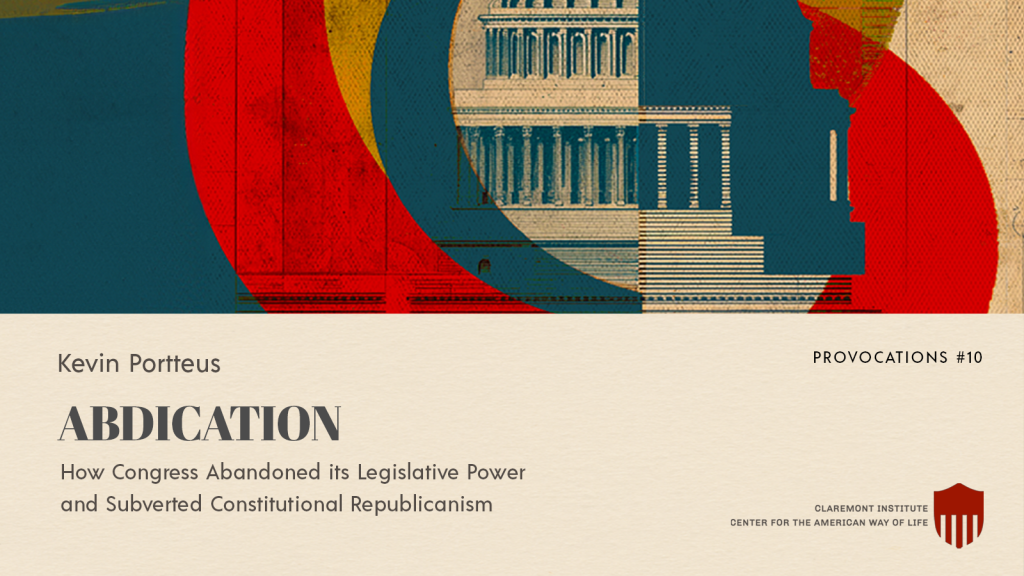
Summary: The United States Constitution declares that “All legislative Powers herein granted shall be vested in a Congress of the United States.” Yet, over the past century, Congress has divested its legislative power to the courts, to the president, and to an ever-expanding administrative state. Why would legislators come to believe that it is in their best interest to no longer legislate? Can a constitutional republic endure when the people’s representatives no longer deliberate and pass laws? In this Provocation, Kevin Portteus traces the rise of delegation, explains how it transformed Congress and the American regime, and asks whether constitutional government can be restored by forcing Congress to legislate again.
Click the image above to read this essay. Click here to view a PDF version. This essay is available in hard copy, audiobook, and e-book formats on Amazon.

Summary: Establishment media and politicians have raised alarm over President Trump’s efforts to cut the federal bureaucracy and make its top officials more loyal to him and his voters. How did we reach a point where national administrators—who wield immense power—see themselves as independent of the elected president? Why does it alarm elites when he expects the bureaucracy to carry out his program? The roots of this attitude go back to the original Progressive project to reshape American government. We are now witnessing the first serious effort since the 1930s to restore democratic accountability. In this Provocation, Ronald J. Pestritto explains how we got here—and what comes next.
Click the image above to read this essay. Click here to view a PDF version. This essay is available in hard copy, audiobook, and e-book formats on Amazon.